Posts

Hainault Forest and Barbastelle bats
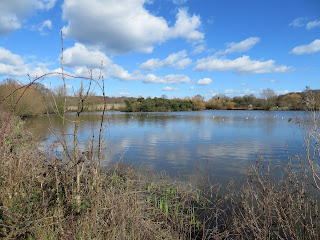
Image
Lake in the Country Park If I had been keeping my blog in 2004-08, I might have written about Hainault Forest, one of my favourite open spaces in the LB of Redbridge. But I wasn't, so I didn't, but will make up for it now that I am revisiting the sites that I surveyed >ten years ago, to see how they have changed. Hainault Forest is one of the remaining sections of the former Forest of Essex.  In a survey made for Henry V111 in 1544 its extent was some 3,000 acres. The forest land was condemned as a waste in 1851, and deforested; the deer were removed, and 92% of the old growth forest cut down. Hornbeam and beech are it's characteristic tree species including pollards of the former. The land became marginal agricultural land and subsequently a significant proportion has been built on. Redbridge manage the country park and the Essex side is managed by the Woodland Trust who are in the business of reforesting .   This link to the website - written by local natural...

Kingston enters the Anthropocene

Image
Tree felling Kingsmeadow S. Kay    Last year I sent a Christmas letter to 48 councillors - asking them to attend to the environmental destruction occurring in the borough - which you can see here biodiversity-air-and-water-letter-to-48. But unauthorised tree felling continued during January, captured so well by several witnesses attending Kingsmeadow in an attempt not only to halt the felling of a row of healthy Monterrey Pines - and other mature trees- but also the tipping of several cubic metres of contaminated soil down the riverbank in order to construct a new discus throwing area, without the necessary planning permission or ecological impact assessment reptiles-in-borough     One of the 28 policies in the Kingston Tree Strategy is that 'permission will not be given for healthy trees to be felled'. So I thought it prudent to remind councillors of their biodiversity duty under the Natural Environment and Rural Communities Act, 2006 at the Environment a...

On the subject of Mulberries

Image
 Since October Dr. Peter Coles - at times in conjunction with the Museum of Walking- has been  showing us London's mulberry trees. As we were standing looking at the pictures of the former site of the Lewisham silk mills, a by- passer remarked that her mother knew the mills in the 1930's - and they had coincidentally just planted a mulberry with Lewis from the  Orchard Project, just a 100m from where we were standing. The history of silk goes back some 5,000 years. Discovered in China the closely guarded secret of its manufacture found its way to this country via the Silk Road and the trade routes of the world. From the Inns of Court to Keats House Museum, to Victoria, St. James' and Green Park we have seen-on Peter's walks- white and black mulberry trees hailing from the time of King James when he tried to kick start a silk industry; or the remnants of a former silk industry brought over by the Huguenots; or the specimen trees, which were a must have for e...

Longford River walk

Image
    The 111 bus will go as far as Park Road at Hanworth Park where you can comfortably walk back to Kingston in four hours along the Longford river, which is owned and managed by the Royal Park's Authority. The River was created to divert water 12 miles from the river Colne  to Bushy Park and Hampton Court Palace, where it reaches the Thames  near Teddington Lock. It supplies all the water features in Bushy Park including the Water gardens. Although the river is mostly culverted in Hanworth park it is possible to obtain views at the north west and north east extremities -as well as around Hanworth Park House- where we spotted a high flying buzzard. Hanworth Park House dates back to 1802, wings and a clock tower were added in the early Victorian period. This mansion replaced a Tudor building, burnt down several years earlier, that had been used a hunting lodge by Henry VIII to access Hounslow Heath.     The House became a military Hospital du...

London's House Sparrow populations: Ilford town centre

Image
  Thirteen years ago - at the behest of LB Redbridge - I walked around with a sign on my back asking people to tell me about their house sparrows. Ilford had an impressive population of house sparrows that appeared to be thriving in the town centre. The aim was to identify features that the birds depended on, so that they could be retained in the regeneration. This year I decided to revisit some of these sites. The decline in house sparrow numbers has already been well documented in Britain where sparrow numbers are believed to have fallen by 70-90 per cent in the past 15 years. House sparrows are  declining all over the country, but primarily the decreases have been in the south-east of England, with the worst hit area London itself. Indeed, 7 out of 10 of London’s sparrows have been lost since 1995, and we know that the decline started long before then. Although it is still a relatively common bird in the UK we have lost almost 12 million house sparrows ...

Kingston's Drove Roads

Image
  Many of you accompanied Lucy and myself along the drove roads of  Tolworth for a picnic during 12.8.18. Earlier this week Bruce 'of the drove roads' www.localdroveroads.co.uk - arrived at Tolworth Station from his home in a small village at Carmarthenshire. Ironic, as it was the arrival of the mainline railway in the 1840's that made our local trackways redundant for the movement of cattle.     Our first stop was to walk the old Kingston Road to the 'Moated Manor' site aided by some context provided by the writings of  Richard Jefferies - a former resident of  Ewell Road (where there is now a blue plaque above Stack and Bonner). R.J. wrote of the cows walking along the Ewell Road with their heads moving from side to side c1877. This would have been post - drovers, as by then the railways were used for moving cattle around the country, so these animals might have walked from Surbiton Station.     We disturbed the usual buzzard as we op...

Opportunity Areas: whose opportunity?

Image
Opportunity areas in Kingston   The bloggers will be burning the night oil after each of the Examination in Public (EiP) hearings of the Mayors London Plan. Some of yesterday's session on Opportunity Areas and Regeneration, is expounded below see also Kingston's emerging Local Plan Whilst no one wants to stop genuine homes being provided for our citizens - shelter is a human right - many are concerned about the way this is being undertaken. The inclusion of much of Kingston as 'Opportunity Areas' to deliver housing targets of 30,000, has raised a number of questions- including from our council - who want to see this number halved. The London Tenants Federation as well as many  other organisations  are calling for a halt in the spread of Opportunity Areas. OA's can mean that normal planning rules are suspended and density increases can be up to 300% ABOVE  average new development. They determine that an area can take extraordinary numbers of jobs and ne...