Posts

Showing posts with the label brown long-eared bat

Hainault Forest and Barbastelle bats
Image
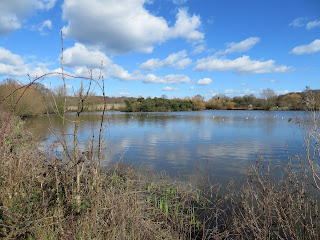
Lake in the Country Park If I had been keeping my blog in 2004-08, I might have written about Hainault Forest, one of my favourite open spaces in the LB of Redbridge. But I wasn't, so I didn't, but will make up for it now that I am revisiting the sites that I surveyed >ten years ago, to see how they have changed. Hainault Forest is one of the remaining sections of the former Forest of Essex.  In a survey made for Henry V111 in 1544 its extent was some 3,000 acres. The forest land was condemned as a waste in 1851, and deforested; the deer were removed, and 92% of the old growth forest cut down. Hornbeam and beech are it's characteristic tree species including pollards of the former. The land became marginal agricultural land and subsequently a significant proportion has been built on. Redbridge manage the country park and the Essex side is managed by the Woodland Trust who are in the business of reforesting .   This link to the website - written by local natural...

New bat species recorded for Kingston!

Image
What bat is that (photo, M. Wagstaffe).    Five bat species were caught at a Chessington location, during a harp-trapping session, convened by members of local Bat Groups as part of the National Nathusius' pipistrelle project.  This included several common and soprano pipistrelle bats; two Daubenton's bats; a brown long-eared bat and another that took observers a little time to identify.   By looking at the dentition under a magnifier it was possible to see which of the small Myotis bats matched  the cusps and protocones present or absent on the teeth. It turned out to be a whiskered bat; there are no recent records for this species in the borough. This is because the genus is difficult to record on bat detection equipment, emerging slightly later than pipistrelle bats and as a woodland specialist has specific habitat requirements. At a similar trapping session at Kempton Park, a whiskered bat was caught in the harp-trap which was a first f...

Bats and lighting

Image
Brown Long Eared bat photo S. Sivanesan This brown long-eared bat (Plecotus auritus) is one of the bats brought into care last year as it weighed only 4g - half optimum. We still have a small population of this species along the Thames, due to the  ideal habitat provided at Home and Bushy Park Site of Special  Scientific Interest. Plecotus bats are light - shy,  along with the genus Myotis (Daubenton's bats)  and are at a competative disadvantage with those bat species, which fly and foragage over more open habitats. This means that they are special in London. Recently, Richmond Council placed 20 cowls onto the the luminiares overlooking the Wick Pond to reduce the light spillage onto the water. We are not so lucky in Kingston, where development along the river has led to light pollution noticeably reducing the number of bat (and other nocturnal) species -and their abundance- routinely recorded along the Thames at Canbury Gardens and Queens Promenade, ...

Mr Biscuit, the brown long-eared bat

Image
Photos taken by S. Sivanesan at feeding time. Diet of mealworms Lovely as they are, I pretty much dread getting brown long-eared bats to look after; as they do not like being captive and often fail to thrive. Mr Biscuit (named by the family that found him) was an exceptional bat, that was able to increase his weight from 6gs to 8.5gs in only ten days. He quickly learnt how to feed himself on mealworms, a diet these animals would never encounter in the wild; and then he soon learnt how not to feed, in order to get me to feed him, so he could fall asleep in the warmth of my hand! Taking liquid Brown long-eared bats rarely leave the canopy of woodland and so they are usually found  at  few local sites in our urban landscape, including the greenbelt and the larger parks. The only known local maternity colony was lost a few years ago due to the development of Normansfield hospital and now all local records pertain to solitary animals (rather than a colony).  T...

Seething Wells: the best site in the borough for bats with a new bat species for Kingston

Image
10 species of bat are now recorded at the the Filter Beds site and the adjacent river side. This is more than any site in the borough, with 5 the greatest number for a Kingston site (with the exception of Canbury Gardens and riverside). A Myotis bat with the call characteristics of a Brandt's bat, was recorded along the river wall during the developers surveys. This is the first ever record of this species for the borough. The ten bat species now recorded at the site are as follows: Pipistrelle bats: all 3 of the following pipistrelle species were recorded during the surveys by EDP (acting for Hydro Properties): Pipistrelle bats are found wherever there is connecting local green space and there are  some large soprano pipistrelle roosts in Surbiton. Early registrations of this species are  associated with the northernmost  Filter Bed, and  includes occasional use of the small pumping station at Seething Wells, which the consultants do not  accept ...