Posts

Showing posts with the label Noctule bat

Waterworks meadow and Waterworks nature reserve

Image
Waterworks meadow where I have had the pleasure of leading bat surveys this year.     Waterworks Meadow forms a key component of the Lee Valley Regional Park; the Waterworks Meadow site is approximately 8 hectares in size. It is not subject to any statutory or non-statutory nature conservation designations. It lies adjacent to part of the Lee Valley Site of Metropolitan Importance for Nature Conservation (SMINC) including the River Lea, which bounds the site to the south-east and south-west. It is adjacent to - and not to be confused with - the Waterworks Nature Reserve, which forms part of a waterworks complex. The meadow used to be a pitch and putt golf course and then a brief spell as a centre for pony trekking. In an effort to find a profitable use for it the owners have been looking at various options. Earlier this year a licensing application was submitted to Waltham Forest Council for an 8,000 person 'Waterworks Festival' on the meadow.  The Save Lea Marshe...

Bat Activity at Seething Wells 30.7.20

Image
Five species of bat were recorded from positions along the Portsmouth road Filter Beds last night: Noctules from 21.04 Soprano pipistrelle from 21.18 Common pipistrelle from 21.53 and Daubenton's bat from 22.05     Nathusius' pipistrelle passes were recorded by a surveyor positioned at the north end of the site and are not included in the plot. The majority of the pipistrelle passes were recorded at the northern end. The brown path indicates the movement of the surveyor and the bat symbols are automatically generated and georeferenced. That is: GIS or mapping software can 'place' the image in its appropriate real world location . So we can only detect bats that come within 20m of bat detection equipment and we cannot know what is happening in the areas closest to the river. As it grew darker and sand and house martins were replaced by bats, we also saw 2 Jersey tiger moths nectaring on buddleja.

Hainault Forest and Barbastelle bats

Image
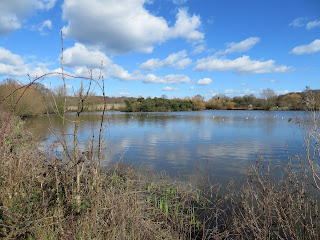
Lake in the Country Park If I had been keeping my blog in 2004-08, I might have written about Hainault Forest, one of my favourite open spaces in the LB of Redbridge. But I wasn't, so I didn't, but will make up for it now that I am revisiting the sites that I surveyed >ten years ago, to see how they have changed. Hainault Forest is one of the remaining sections of the former Forest of Essex.  In a survey made for Henry V111 in 1544 its extent was some 3,000 acres. The forest land was condemned as a waste in 1851, and deforested; the deer were removed, and 92% of the old growth forest cut down. Hornbeam and beech are it's characteristic tree species including pollards of the former. The land became marginal agricultural land and subsequently a significant proportion has been built on. Redbridge manage the country park and the Essex side is managed by the Woodland Trust who are in the business of reforesting .   This link to the website - written by local natural...

Today's letter to the Comet

Image
Dear Surrey Comet, I was disappointed with the lacklustre Comet article regarding the Seething Wells Filter Beds, Public Meeting that was held last Thursday. It didn’t capture the buzz or the passion in the audience, nor expound some of the very exciting news that has arisen from more thorough surveys undertaken by the company employed by the developers (who surveyed a larger area, for a longer period, during 2012).  An entirely new bat species has been recorded for Kingston and one which is extremely rare nationally. This has been named as a Brandt’s bat by the surveyors, although technically it is very difficult to identify unless in the hand and more properly termed a bat of the Myotis genus, most likely a Brandt’s bat. This indicates that suitable foraging is found along this, the most darkest and most undisturbed stretch of the non-tidal river Thames in London. It raises the possibility of the species hibernating within the barge tunnel (along with two additional Myo...

Kingston University Batty Boat Trip 25.7.12

Image
During the July Batty Boat Trip  twenty people watched Daubenton's bats emerging from their roost at the Filter Bed site. There doesn't seem to be so many bats this year and they are not in their usual hurry to emerge. Maybe the colony hasn't found the weather conditions so favourable or perhaps they have suffered due to the drainage of their foraging grounds. Studies carried out during the late 1990's and early 2000's found large numbers of Daubenton's bat spent a substantial amount of time foraging over the Filter Beds. For more on Daubenton's bat ecology see:  benton the bat Six species of bat were recorded  in all during the trip: common and soprano pipistrelle, Daubenton's and natterer's bat, noctule and Leisler's bat.