Posts

Showing posts from May, 2016

Hogsmill Sewage Works : dry outfall

Image
April May: no water leaving  the sewage outfall  80% of the water in the Hogsmill above the site in the photographs - the Hogsmill Sewage Works outfall - is actually treated sewage effluent. The rate of discharge can be demonstrated on the left hand side. This is only the second time in twenty years I have ever seen a dry outfall. What are the consequences for the resident fish and invertebrates of a drying river channel ? (as per the May photograph).  What are the knock-on effects for kingfishers, who depend  on feeding their young on a diet of small fish and invertebrates (small crustaceans etc). One guaranteed consequence is that pollution from the many misconnected drains along the water course will have a much greater impact on both water quality and river ecology. More 'rag' apparent

Cuckoo on Ham Lands

Image
Since the dawn chorus walk 17.4.16 - the migrants have arrived! Listen out for the cuckoo  heard by some local dogwalkers. Residents have seen common terns along the Thames close to  the lock. These are probably fishing in the lagoon at the Thames Young Mariners site.  The reedbed has been burnt and may not be suitable for visiting sedge and reed warblers this year, although the hawthorn scrub is alive with warblers ; with many whitethroat, 3 lesser whitethroat and one garden warbler heard last night. Swallows and swifts are in the air at last and hopefully we will see more of the sand and house martins. A pair of bullfinch along with two pairs of stock doves are the 'resident' specialities.

Commemorative Trees, Fairfield, Kingston

Image
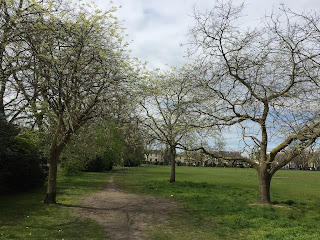
Some of the borough's trees  have been planted to recognise an event or passing of  a loved one. The three on the left, were planted by former Cllr., Julie Reay (and others) to commemorate the laundresses who worked in the Kingston laundries. The Surrey Comet 15.6.1872 stated that 'there was an open air demonstration of washerwomen on the Fairfield'. The women, known as tub-thumpers- earned an average of 2s 6d per day plus a free pint of beer for working an 11hour day. They worked calf deep in water and suffered many ailments, such as trench foot. In 1872 a number of laundresses went on strike and this has been documented in 'A dramatic account of the Kingston, Surbiton and Norbiton Washerwomen's strike of 1872' edited by John Pink of Grove Lane. In 1922 they attempted to unionise and rallies were held also on the Fairfield, leading to a number of arrests. Stables, starch tub Hilton, Sheraton hotels When the laundry in Bonner Hill Road clos...

Monitoring the Hogsmill : eel trap and rag removal

Image
Joe Pecorelli from ZSL The eel trap was reinstalled by Joe on 20 April 2016 to allow monitoring of this year’s eel passage. The first eel of the season was recorded during the second check of the year, and on 29 April 2016 three eels were found. The eels are transferred to a bucket, where they are measured before being carefully returned to the river. Most of today’s catch belonged to a similar age class, although a much larger eel was observed further upstream near the cemetery later that day. Look out for eel traps along other rivers such as this one at Teddington Lock Emptying the trap Kingston University is running another eel training event during May, so if you are interested in helping out at any point from April to September with the checks, please sign up for the training (see the Kingston University biodiversity blog). Some not so good news with the river monitoring (see March, 2015 posts) : three out of the four RMI monthly checks have found breaches in trigger...