Posts

Centenary Walk: Richmond Park, Kingston Hill and Wimbledon Common

Image
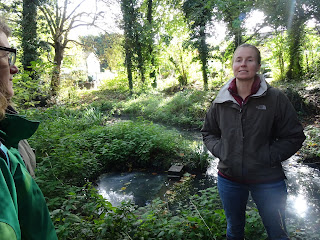
Elizabeth finds Crassula    Led by members of the London Geodiversity Partnership and supported by the Friends of Richmond Park and the London Natural History Society, 35 of us celebrated one hundred years since the original GA excursion 19.5.17. We started at Gallows pond, a large landslip near Thatched Cottage House, where there are now two ponds on the springline; one was filled in due the appearance of an invasive species Crassula helmsii aka New Zealand pigmyweed. Unfortunately it appears to be back.      Government noise monitor The new masts appearing around the park are monitoring  noise and pollution from Heathrow.     Claygate beds Members of the GP demonstrated the plasticity of the  London clay,  terrace gravels, 'bunter' pebbles (transported by tributaries from the north) veined quatz, and lower greensand churt (used as a building stone near Guildford); Cynipid wasp, Neuroterus quercusbaccarumtion   Members of...

Mr Daubenton

Image
 Louis-Jean-Marie Daubenton (May 29, 1716 - December 31, 1799) was a French naturalist who gave his name to Daubenton's bat Myotis daubentoni see http://en.wikipedia.org/wiki/Daubenton

Swifts are in

Image
Swifts are among the last summer migrants to arrive and around the first to leave our shores. Some birds were recorded over Island Barn and Staines Reservoir last week, and my records show that this is the week when they usually arrive in Kingston and are found feeding over Pen Ponds. Breeding still takes place in Berrylands (14) with young fledging around the first week of August. Peak numbers are recorded from birds breeding at Bushy Park, Hogsmill Sewage Works, R. Thames, and Sunny Surbiton with the favoured deep eaves that characterise properties in and around Maple Road. Swifts  spend most of their life on the wing, including sleeping and mating. There are useful facts on swift biology here https://www.rspb.org.uk; although I find this website the more pertinent for the airing of issues surrounding the perilous decline of this bird http://swift-conservation.org Between 1995and 2011 we lost about a third of the birds that nest in Britain. A major reason for this was the ...

Orchard Day, Dorich House, Kingston Vale

Image
Lewis McNeil London Orchard Project    The rain subsided just in time for our enjoyable demonstration - performed by Lewis from the London Orchard Project - on how to maintain the orchard, at Kingston University's Dorich House at Kingston Vale. The original inhabitant - sculptor Dora Gordine - was keen on fruit, and the original apple and pear trees were reaching the end of their useful lifespan; although dead wood on healthy trees are a recognised asset for biodiversity, and is not cut out.  choosing a vertical limb The orchard was  restored and revitalised in 2011 by LOP. This included some supplementary planting of local heritage varieties such as Braddick's Nonpareil and Claygate Pearman, orginally grown by John Braddick of Thames Ditton late 1900's. Apple trees are flatter than the more upright pear trees and the wider angles take greater loads.  When trees are not pruned regularly they can revert to biennial bearing; with a lot of fruit one year...

Belted Galloway herd and Surrey Wildlife Trust.

Image
    We visited Pond Farm, Wisley and Ockham Common, close to Wisley village off the A3. This site is managed and grazed by the Surrey Wildlife Trust and their herd of Belted Galloways; who appreciated their top-up of hay after the recent snow fall.   Surrey Wildlife Trust run an exceptional service delivering a grazing programe tailored to suit most sites. They match the temperament of the cattle with the level of use. Category one, sites are those in the most urbanised areas, requiring cattle to be habituated to dog incursions. However, no herd should ever be expected to cope with illegal dogs running out of control on a nature reserve and sensible control of animals on leads may be required. The off to Priest Hill LNR and public open space along the Banstead Road (parking in Beverley Close) to see the 22 strong herd in the snow. On the heels of the cattle was  a flock of c20 meadow pipits hopeful of tid-bits grazing would reveal. This would be a great mod...

Wassail: Hook to Tolworth apple walk

Image
    We held a wassail this weekend - paying homage to fruit trees along our way - as well as local figures important in Kingston's Pomology or apple story. Our walk began in Hook, close to the former home of the founder of the heritage apple 'Colonel Yate', which was raised by nurseryman W H Divers of Surbiton (c1905); we continued to look for apple references as we traversed Orchard Gardens, Apple Grove, Cox Lane towards Tolworth Court Farm.  En-route we visited Causeway Copse (now know as Bullwhips- when did the council change its name?) where wild Malus species have been recorded according to the London records centre (Greenspace Information for Greater London or GIGL). We left votive offerings or 'gifts' - in the form of small pieces of toast - traditional, particularly in cider growing regions. In the eastern fields at Tolworth Court Farm we found bird species associated with  orchards, such as  redwings,  often found searching for any rema...

Vegetation clearance at Seething Wells

Image
Bulldozing of vegetation and leaving it in opposing piles is not a great way to manage a Site of Nature Conservation Importance.     Exposing the subterranean chambers and other features of industrial archaeological importance; usually occurs when a planning application is in the pipeline.      For the time being the filter beds are  still home  for  the heron, fox and  lapwing  along with many other species seen today: redwings, robins, blackbirds, song thrush, pochard, tufties and gadwall.

Wassailing or Wasseling

Image
New orchard Alexandra recreation ground Berrylands    Peri-urban habitats in the south of the borough are radically altered; but orchards can maintain a wonderful wildlife habitat. The longer grass between trees can be a haven for wildflowers and insects; surplus fruit is appreciated by  winter  Scandanavian thrushes (redwings and fieldfares). There are some excellent blogs on orchards and their wildlife. http://brightwellorchards.blogspot.co.uk/ See also http://www.abundancelondon.com/ with excellent posts from K. Leibreich on the situation in south-west London fruit growing stronghold in Chiswick and Isleworth. https://www.theguardian.com/global/blog/2016/jan/11/community-belonging-values-discovery is an account of wassailing in an Oxfordshire village. The tradition of wassailing (also wasselling) into two distinct categories: The house-visiting wassail and the orchard-visiting wassail. The house-visiting wassail is the practice of people going doo...

Green Lane Stream, tributary of the Hogsmill

Image
This is the spring of one of the Hogsmill tributaries aka Green Lanes stream. It rises near West Hill in Epsom on the southern tip of Court Park. Despite some initial gurgling - no water was apparent throughout the park. Longmead Road    The route is along a stand of spectacular oak trees, many >300 years old. Great spotted woodpeckers were enjoying the grubs activated by the warmth of the winter sun. The stream is again lost along Pound Lane and the Primary School until it reaches Longmead Road where it emerges via several outfalls, a mixture of stormwater, road run-off and some misconnected pipework.       A strong ammonia odour becomes apparent once reaching the Thames Water storm tanks opposite Blenheim School, where the pong penetrates the winter air for the remainder of the  Longmead Road stretch. The rag-coated grillage attests to  recent sewage overflow  into the stream- despite the low rainfall- and is indicative of th...

Tributary of the Hogsmill river

Image
This little wildlife corridor, marked here by the black arrow, rises close-to (and feeds) the lakes at Horton CP Golf Course. It flows towards the Hogsmill at Scott's Farm Close where it can be viewed at three places; this is after snaking through  back gardens into the playing fields at Epsom and Ewell High School. Here it is heavily engineered with double and triple weirs. Evidence of the stream's existence above ground is marked by the straighter - than - natural  line of trees  along  rear boundaries of properties along  Gadesden  Road. As Scott's Farm Close meets Gadesden Road there is a public right of way across school playing fields to Ruxley Lane where the stream can just about be seen (below left).      There are additional views at Chessington Close as the stream emerges from under the busy B284 road, traversing a more natural course through gardens - initially along their boundaries - but thereafter via a cherished sea...

More urban rivers: The Ravensborne

Image
Deptford creek River restoration has been a topic of recent posts, the Ravenborne was amongst the first river in the region undergo this treatment. European LIFE funding as part of a massive urban renewal project has regenerated the centre of Lewisham. At low tide, it is possible to walk along Deptford Creek, where the Ravensborne ends its journey to the Thames. Here riparian developments have led to some interesting planning gain (on the Lewisham rather than the Greenwich side). terraces topped by sand martin bank Sheet piling may be the cheapest way of protecting the bank or freeboard but this is useless for wildlife. The  best option is some form of terracing but this is expensive and often tricky to match to the vagaries of tidal water. When properly undertaken and well managed to remove invasive species, the terraces give rise to excellent habitat for plants and fauna of brackish water, where some unusual species have been recorded including a hybrid between Japanese...

Kingston Cemetery Fungi

Image
Dryads saddle on horse chestnut     Its rather late in the year to be looking for fungi; the dry autumn and the long grass have meant there has not been much to see. Whilst some species benefit from infrequent mowing - others  do not - wax caps and the corals definitely prefer the shorter, warmer grass.    Wax cap sp.   Some birds prefer shorter grass as they find ants on shorter turf, which is exactly where we found the droppings of the green woodpecker, which resembles a burnt out cigarette (see photo).   Most of the fungi therefore was located on the boles or stumps of old trees such as the honey fungus on the tree outside the Dawson Road gate- no sign of the orange peel fungus that was present last year. The Inonotus hispidus on the ash with the many woodpecker holes (walk in the main gate and turn left). Green woodpecker dropping These are all important contributors to the web of life and it was possible to see the fungus gna...

Rainscapes in LB Enfield

Image
    Following the London Urban Water Management Conference, Thames21 and Enfield Council  organised a tour of the Rainscapes last Tuesday. It was great to see the sites in the raw as well as talk to members of the local Friends groups.  blocked drain and swale Our first stop was at Lonsdale Road and Aimee Felus from Thames 21 and Ian Russel the borough engineer at Enfield council showed us some of the impressive schemes they had colaborated on, that were custom designed to prevent polluted storm water run-off from entering the streams. This included deculverting part of the hidden Glenbrook river along a woodlot .  Misconnections from sources of sewage entered the river through various outfalls but are hidden under the road. Here they are seen and can be dealt with and the process starts with a boom to hold back the worst excesses of pollutants, most recently this has been cement washed into drains from building works which has left an amount of whit...